

03 Feb 2026 Mr. Santosh Agrawal (Author is the Chief Architect for ZeaCloud and Managing Director Esconet Technologies Ltd.)
A few years ago, I was sitting in a late-night war room with a customer whose production database had just gone bad. Not “server down” bad. Worse. The application was running, users were logged in, but the data was quietly corrupted. No alarms. No crashes. Just wrong numbers showing up in the morning reports.
That night taught me something that slides and datasheets never do. Backup and replication are not one thing. They are philosophies. And the differences between snapshot-based backups, CBT-driven systems, and journaling-based technologies matter more than most people realize.
Snapshot-based backup is the most familiar. You take a picture of the system at a point in time. Midnight. Every hour. Maybe every fifteen minutes if you are feeling ambitious. These snapshots are easy to understand and easy to restore. They work beautifully for hardware failures, VM crashes, and accidental deletes that are noticed quickly.
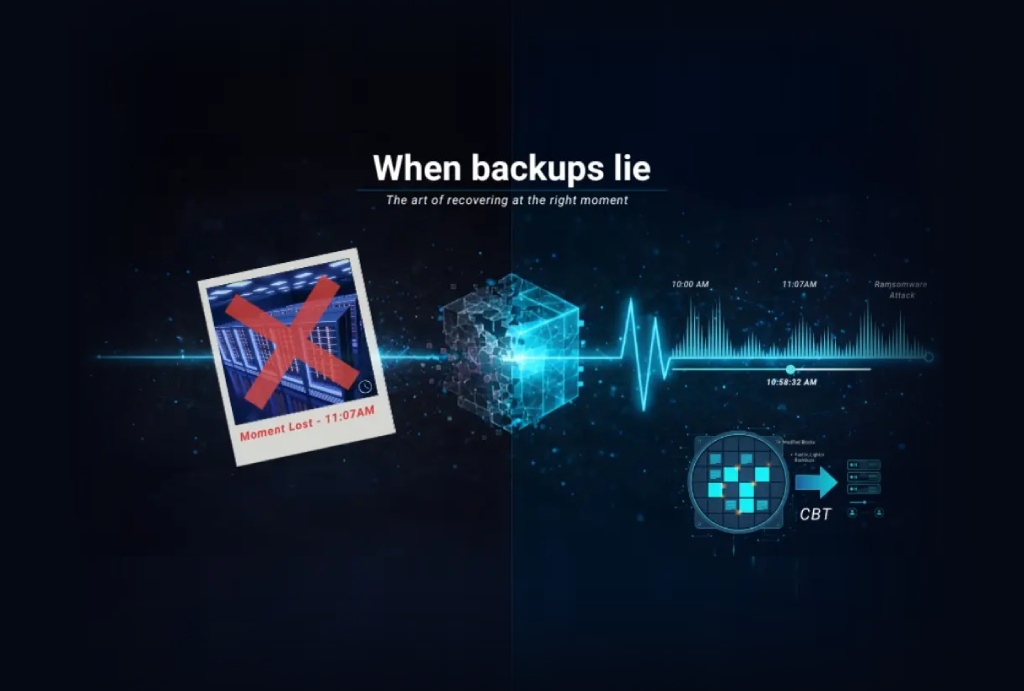
But snapshots have a blind spot. Time between snapshots is dark space. If something bad happens at 11:07 and your snapshot was at 11:00, you already lost seven minutes of data. Sometimes that is acceptable. Sometimes it is not. Snapshot-based systems are cost-effective, predictable, and still the backbone of most environments. They are photographs in an album. Clear. Useful. Limited to the moments you chose to capture.
Instead of copying the entire disk every time, CBT marks only the blocks that were modified and moves just those blocks during the next cycle. This makes backups faster, lighter on bandwidth, and more scalable. Most modern snapshot-based systems quietly rely on CBT under the hood.
But CBT does not remember when a change happened or in what order. It cannot rewind time. It simply helps the system move data faster between snapshots. Think of CBT as a highlighter that marks edited pages in a book. Useful. Essential. But it does not tell the story of how the book evolved.
Journaling captures every write as it happens and records it in order with time context. Instead of jumping between snapshots, you get a continuous timeline. You can roll the system back to 10:58. Or 11:06. Or ten seconds before a ransomware payload started encrypting files.
This is why journaling is often called Continuous Data Protection. It gives you second-level recovery points and protection against logical failures, silent corruption, and modern ransomware attacks. The tradeoff is cost and complexity. Journals consume storage. They require tight integration with compute, storage, and networking. They demand operators who understand failure modes, not just restore buttons.
Back to that late-night incident. The snapshots were fine. The CBT was working. But the corruption had crept in slowly between backup windows. What saved the customer was a short journaling window that allowed us to rewind to the exact minute before the bad transaction hit. No guessing. No compromises.
Snapshots are perfect for general workloads, dev environments, and cost-sensitive systems. CBT makes them efficient and scalable. Journaling is reserved for mission-critical systems where data integrity and recovery precision are non-negotiable.
Understanding where each fits is not theoretical for us. It is operational muscle memory. We design hybrid protection strategies where snapshots handle breadth, journals handle depth, and immutable backups handle compliance and worst-case scenarios.
Migration and data protection are not about tools alone. They are about judgement. Knowing when a photograph is enough and when you need a full flight recorder.
That nuance is what the ZeaCloud team brings to every engagement. We do not just move your data. We understand how it breaks, how it fails quietly, and how to bring it back cleanly. In a world where outages are obvious but corruption is subtle, that difference matters more than ever.